Measure, monitor, act: Walloon expertise designed for remote deployment
At Finemeca, we rarely start from a blank sheet. The meters are already there, the electrical cabinets too, the equipment has often been running for years, and every building has its own history. Our first task is therefore to understand what is already in place, retrieve the available data and add measurement where it is missing.
The aim is not to connect equipment simply for the sake of connecting it. Data is useful only when it helps people understand what is happening, detect a deviation, compare situations or make a decision.
This can involve electricity, water or gas consumption, the operation of technical equipment, but also the performance of a production line. In the latter case, monitoring operating time, downtime and actual equipment performance helps give meaning to indicators such as OEE.
Measurement, however, is only the first step. An installation can also be monitored continuously, generate an alert when something unusual occurs and, when required by the project, receive a command. This may involve controlling a valve or acting on equipment when specific conditions are met.
This complete chain, from measurement to action, is what we have progressively structured at Finemeca.
Experience built in the field in Wallonia
On one of our projects in Wallonia, we gradually instrumented several buildings and several types of consumption. Water, electricity and gas had to be monitored, the information had to be centralised, and users needed to be able to visualise the data and receive alerts.
This type of project reflects the way we work. We do not arrive with the intention of systematically replacing what is already installed. A communicating meter, a building management system, an existing supervision system or equipment capable of providing its own data should first be used whenever possible.
We start from what already exists. We add measurement where it is missing and make sure the data reaches the right place.
This approach makes it possible to start progressively. A project can begin with just a few measurement points and later expand to other buildings, meters or equipment. The infrastructure grows according to the real need rather than according to a specification frozen from day one.
A complete IoT infrastructure behind the sensors
What users see is often fairly simple: a meter, a dashboard, a graph or an alert. Behind this visible layer, however, lies a complete infrastructure.
Finemeca deploys an IoT architecture that includes the communication network, device management, the servers required to process the data, data storage, dashboards, alert mechanisms and, when the application requires it, control functions.
LoRaWAN plays an important role in this architecture. It makes it possible, in particular, to connect measurement points spread across a site without having to run new cables to every piece of equipment. But the technology itself is not the main value of the project.
A gateway, a device or a meter can be purchased separately from many suppliers. The real challenge is making the whole system work together coherently, documenting it, monitoring it and turning the collected data into useful information.
This is the expertise we have worked to make reproducible.
Standardising without losing flexibility
With experience, we realised that a significant part of a project could be prepared and standardised.
This is why we structured the Finemeca offering around an Activation Pack and a range of application-specific kits.
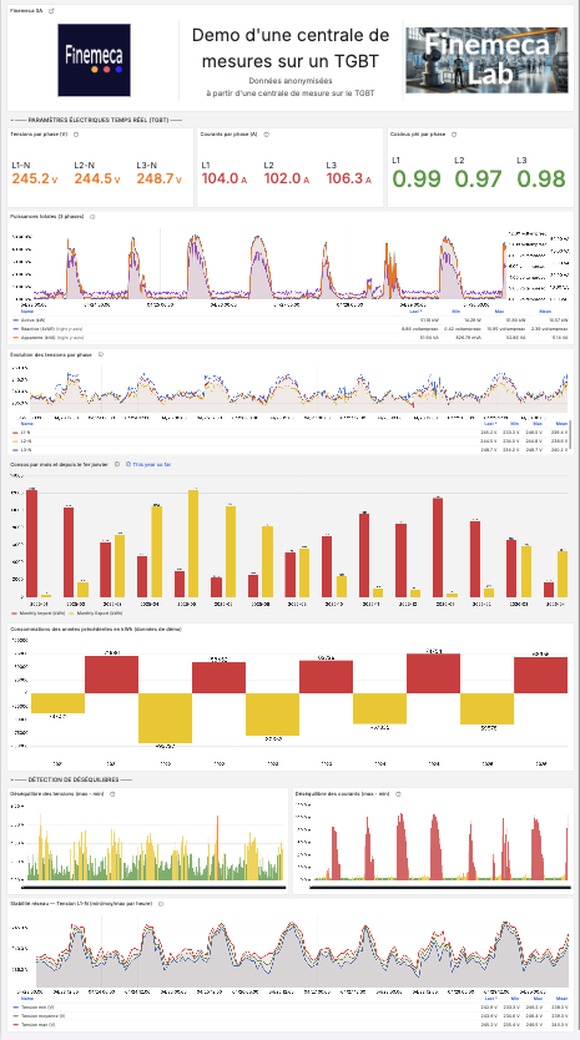
The Activation Pack provides the foundation for deployment. It sets up the infrastructure required to start a private LoRaWAN network and make use of the data. Additional kits then address specific needs such as water or gas meter telemetry, electrical sub-metering or the installation of a power monitoring unit.
The idea is not to create one universal box that is supposed to suit every site. That would run against everything we have learned in the field.
We standardise what can be standardised: part of the hardware, the basic configuration, the commissioning method, data exchange and visualisation tools. The choice of measurement points, integration with existing systems and business requirements remain adapted to the client's real environment.
This structure also makes projects easier to expand. New devices can be added, other data sources integrated and new use cases introduced without having to rebuild the entire system.
A solution designed for remote deployment
This standardisation has another important consequence: it allows us to separate physical presence on site from the expertise required to operate the solution.
For projects close to us, Finemeca can of course intervene directly on site. But this is not essential in every case.
A customer, installer, engineering firm or local partner can take care of part of the installation, while Finemeca remotely handles infrastructure configuration, device integration, dashboard preparation and commissioning support.
This model is particularly relevant when working internationally.
Deploying abroad does not necessarily mean sending a Belgian team for every meter or every intervention. The same architecture can be deployed for a customer in another country, with part of the work carried out locally and another part managed remotely from Wallonia.
The local partner understands the site, installation constraints and the customer's working environment. Finemeca provides the IoT infrastructure, configuration, support and supervision expertise. The roles complement each other.
Exporting expertise, not just hardware
For us, exporting therefore means more than simply shipping equipment.
A kit only delivers value when it is part of a coherent architecture, supported by a deployment method, documentation, supervision and the ability to evolve over time.
This is the model we want to develop: a solution designed in Wallonia, structured so that it can be installed elsewhere and open enough to integrate with the equipment already present at the customer's site.
The needs we encounter here also exist elsewhere. Measuring consumption, monitoring the performance of a production line, detecting an abnormal situation, supervising equipment or controlling an installation are challenges found across many sectors and countries.
The context changes. The equipment changes. The method remains largely transferable.
For Finemeca, this is where the real export opportunity lies: turning field expertise into a sufficiently structured solution that can be deployed by others, while retaining the technical support required remotely.
To discover our approach in more detail, Finemeca presents its different kits, several real-world use cases and a series of technical articles covering energy monitoring, LoRaWAN, measurement and data utilisation.
Discover Finemeca kits:
https://finemeca.com/boutique/kits/#kits
Explore our use cases:
https://finemeca.com/use-cases/#cas-clients
Read our technical articles:
https://finemeca.com/blog/#articles

CTA
Sign up
Complete the application form and adhere to the Charter of Brand Ambassadors