Less well known to the general public than conventional medicines, nuclear medicine is experiencing remarkable growth. Thanks to radioactive substances capable of detecting certain diseases or targeting cancer cells, it is opening up new possibilities for patients, both in diagnosis and therapy. At the European Congress of Nuclear Medicine (EANM) held in Vienna (Austria), Belgian companies and specialists were present in large numbers to showcase their expertise. Their innovations are not limited to treatments and diagnostics. They also concern transport, safety and patient information.
In Wallonia, this boom is supported by a particularly dense industrial and scientific ecosystem. One example? For certain medical isotopes, the Belgian sector supplies up to 65% of global demand at certain times!
A Race Against Time
In addition to the development of new radioactive isotope production facilities in Wallonia, what was striking at EANM was the strong presence of “smaller” Walloon players in the sector. Alongside major companies such as IBA (Louvain-la-Neuve), IRE (Fleurus and Farciennes), the Belgian Nuclear Research Centre (SCK CEN) in Mol, and PanTera (Liège), a number of innovative SMEs were also represented. These companies play an essential role in the entire production and distribution chain of radioactive medicines.
One such company is Vortal, a leader in the manufacture of transport systems for medical radioisotopes. Imagine a medicine that must reach the hospital quickly, whose quality must be verified before being administered to a patient, and which cannot wait indefinitely. This is one of the constraints faced by nuclear medicine professionals. And it is precisely this challenge that Vortal addresses.
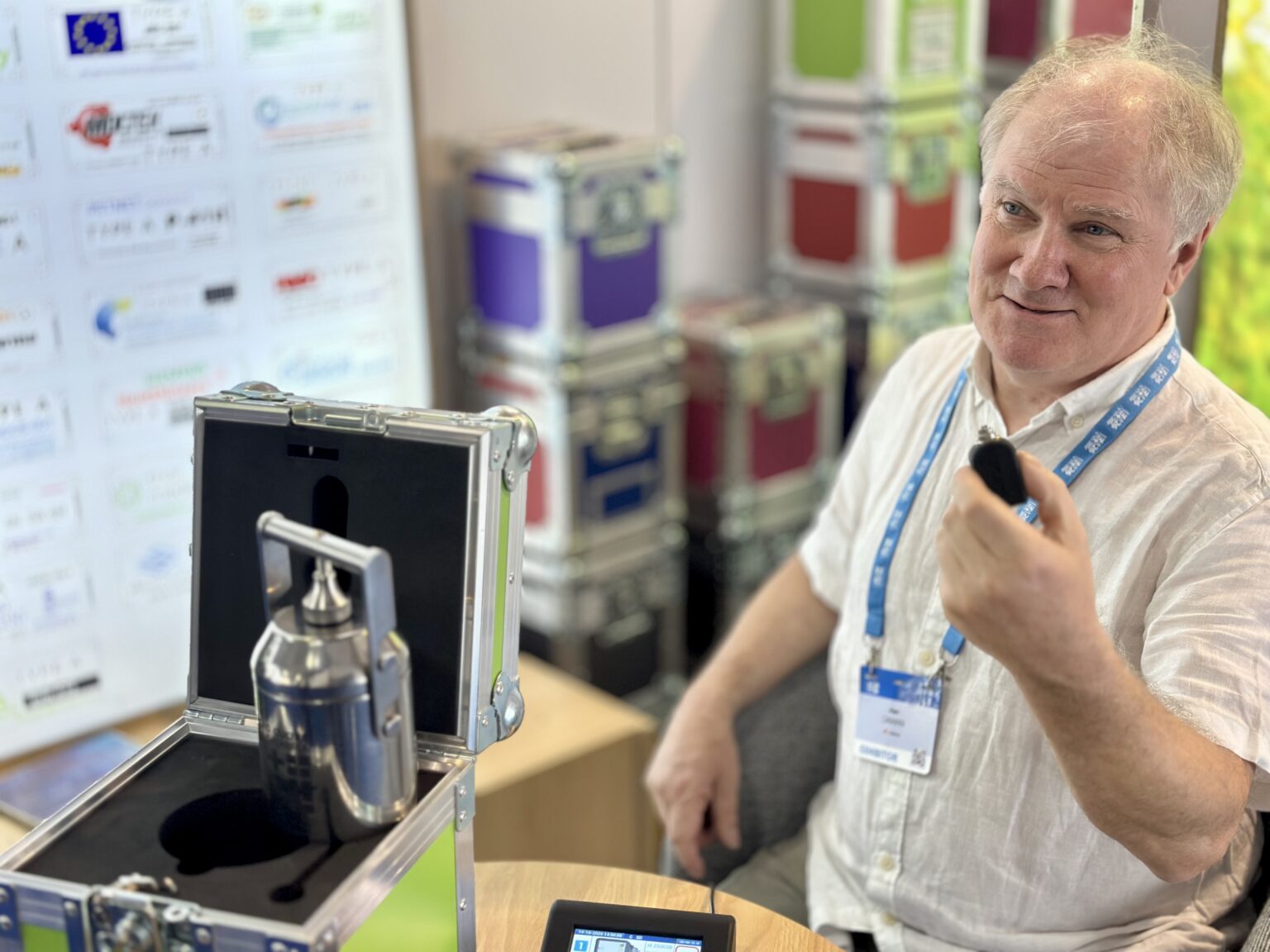
At the stand of the Wallonia Export & Investment Agency (AWEX), Marc Daman, founder of the Mont-Saint-Guibert-based company, presented his latest innovation. It is an electronic locking system designed for the transport containers of radiopharmaceutical products. The system releases the product only once it has been approved for medical use.
For certain medical examinations, notably PET scans, the injection of a product containing a radioactive substance is required. Known as a tracer, it makes certain biological activities visible and must, of course, be certified. However, its lifespan is very short. “In the case of Fluorine-18,” explains Marc Daman, “the half-life of this isotope is 110 minutes.”
In other words, every 110 minutes, the radioactivity of Fluorine-18 is reduced by half. This characteristic is beneficial for the patient, but it creates a race against time for manufacturers and hospitals. The product is therefore shipped in special containers as soon as it has been produced. During transport, a sample from the batch undergoes various tests designed to verify compliance. “Before it can be injected, the medicine must undergo a whole series of tests to ensure that it is not contaminated,” Marc Daman summarizes.
Connected-Lock Transport Containers
His company has developed a connected locking system. The box used to transport the shielded container holding the medical isotope is equipped with an electronic lock that prevents it from being opened until the product has received approval from quality control. Once testing has been completed, the manufacturer sends a code to the hospital, which programs an electronic key capable of opening the transport box and releasing the medicine. This security measure is an essential step in the medicine’s journey, while taking into account the very specific constraints associated with radioactivity.
This clearly illustrates that advances in nuclear medicine also depend on companies that manufacture neither medicines nor imaging devices, but instead make their use safer and more efficient.
Protecting Workers and Patients
Another player in this safety chain in Belgium is Be.Sure. Founded in 2017, the company specializes in radiation protection and supports hospitals, businesses, and research centres that use ionizing radiation. Its mission? To ensure that people working with these types of radiation, as well as patients and the general public, are properly protected.
“Our role is to ensure that workers and the public are not exposed to excessive doses. We also ensure the protection of patients, whether during a diagnostic examination or treatment,” explains Pascal Froment, founder of the company.
In practical terms, specialists visit sites to inspect installations, measure radiation levels, and verify the proper functioning of safety devices. They also assess shielding arrangements and ensure that staff have received the necessary training. Approved by the Federal Agency for Nuclear Control (FANC), the company counts more than 1,100 operators among its clients. These include production sites, hospitals, as well as veterinarians and dentists.
“Radiopharmaceuticals are experiencing very strong growth in Belgium,” Pascal Froment further notes. “New production centres are being built, and we are regularly called upon to support these projects.”
Isotopes and Radiopharma
Radiopharma: the term may sound intimidating. Yet the principle is relatively simple. It involves preparing medicines that contain radioactive substances for use in nuclear medicine. These medicines can be used to detect a disease, treat it, or even do both simultaneously, a concept known as theranostics.
One question remains: how can these technologies be explained to people unfamiliar with them? This is one of the objectives of Nuclear Medicine Europe. At EANM, the European industry association presented its educational website, Hygieia.
The platform enables users to explore and better understand which isotopes are used and in what situations.
“There is no need to create an account or register. The objective is to make information available to the widest possible audience: researchers, academics, physicists, healthcare professionals, and people who are simply interested in the subject,” explains David Crunelle of Nuclear Medicine Europe. The association also develops content for patients, including animations that explain the different stages of a nuclear medicine examination.
Because going to the hospital for a PET scan or another examination can raise concerns. What will happen? Why is it necessary to inject a radioactive substance? How long does the examination take? What will be seen in the imaging room? The animations answer these questions by showing the different stages in a concrete and accessible way.
This approach perfectly complements the scientific and industrial advances being observed in the sector. Nuclear medicine is about far more than isotopes and machines. It also relies on patient trust, professional expertise, and the ability to explain complex technologies in simple terms.
In Vienna, Walloon stakeholders demonstrated that they possess strong assets across all areas of nuclear medicine. From securing radioactive medicines to targeted therapies, industrial production, and scientific outreach, Wallonia is contributing to a major transformation in medicine. According to BioWin, the Walloon health-sector cluster, the sector is experiencing significant growth. According to its calculations, radiopharma represented around 5,000 jobs in 2025 and generated €508 million in added economic value. A figure that, just one year earlier, stood at only €355 million.
By Christian du Brulle, Daily Science.