MIPIM, the International Market for Real Estate Professionals held in Cannes, provides an opportunity to take stock of existing, available or upcoming land and infrastructure in Wallonia to welcome investors looking to develop their business at the heart of Europe.
The Einstein Telescope in Liège
On the occasion of MIPIM, the Liège metropolitan area reaffirmed its ambition to host the Einstein Telescope on its territory, the most ambitious scientific project on the European continent. Far from being a wild gamble, this bid is tangible proof that the Liège metropolitan area has reached maturity. It reflects an already well-structured ecosystem capable of attracting researchers, talent and international investment while maintaining its deeply human DNA.
“This is the project of the century. The presence of a Big Science infrastructure in a region provides an exceptional boost. It will enable leaps in innovation and technological advances for a number of companies wishing to be part of the Einstein Telescope dimension,” said Jean-Christophe Peterkenne, Managing Director of GRE-Liège, during the conference on the subject held at MIPIM in Cannes.
The Cleantech District in Charleroi
In Charleroi, the strategy is to build on historic sectors (technological innovation and life sciences) while integrating new themes (cleantech and agri-food). “Our objective is to work on ecosystem diversity. Our region has never wanted to specialise in a single field of activity,” explains Nathalie Czerniatynski, Director of Economic, Territorial and Strategic Development at IGRETEC.
IGRETEC’s arguments for attracting foreign investors? “Charleroi Métropole is a major economic hub in Wallonia. It is not the middle of the desert. We have a large number of companies of all sizes and across all sectors. You are coming to an economic centre that offers a workforce, training centres and research facilities. It is a genuine economic breeding ground,” she adds.
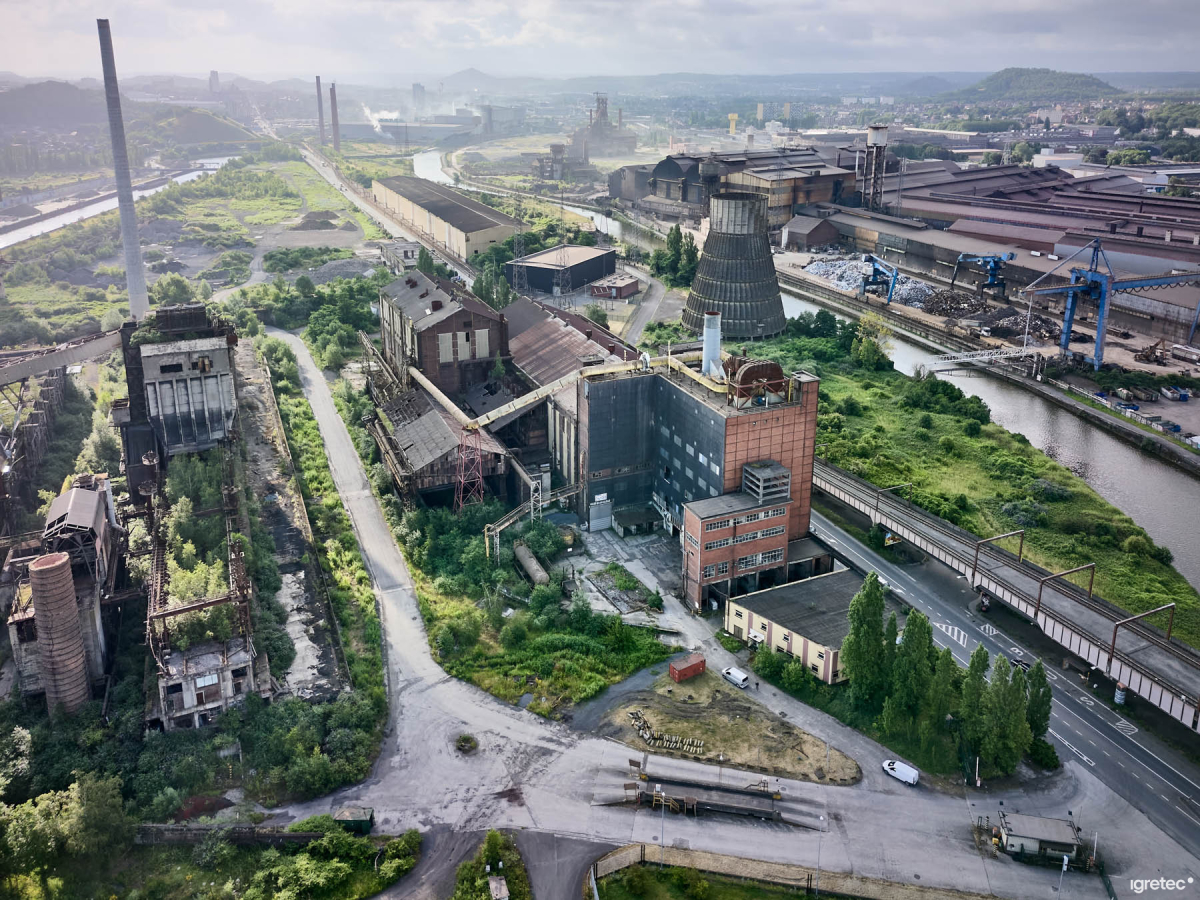
Among the projects presented by IGRETEC at MIPIM is the Cleantech District. In Charleroi, the Cleantech District will soon transform former industrial brownfields at Porte Ouest — including the buildings of the former power plant and changing rooms — into an innovation hub dedicated to clean technologies. Led by IGRETEC and its partners and supported by the Just Transition Fund (JTF), this future campus will host structuring projects serving the ecological transition. Among them, Renolab has already been announced and positions itself as a key accelerator to rethink building renovation in a sustainable, industrial and circular way.
Coworking spaces, offices, plug-and-run workshops and training rooms: everything is designed to foster synergies between the worlds of business, research and education.
The Cleantech District is structured around major cleantech themes: circularity, brownfield redevelopment, soil and water remediation, urban agriculture, as well as cutting-edge technologies such as hydrogen or CO₂ capture and valorisation. The objective is clear: to accelerate the energy and industrial transition of companies in Charleroi Métropole and Wallonia.
Heart for Cleantech in Hainaut
In the heart of Hainaut, the intermunicipal organisation IDEA is working on the “Heart for Cleantech” ecosystem to support two key sectors in the region: agri-food and logistics. “Our ecosystem focuses on materials, eco-circular processes, energy and data, notably with Google’s data centre or I-Care, one of Wallonia’s two unicorns. This ecosystem is designed to support these two sectors. We have a specialised agri-food and eco-construction zoning area in Manage as well as a trimodal logistics platform at Garocentre,” explains Geneviève Finet, Director of Business Development at IDEA.
This is complemented by a genuine Tech Valley currently developing around Google. “It is here that Google developed its first cloud region. Within a 50-kilometre radius of this cloud region, you benefit from a service that is much faster and more reliable than anywhere else. We also have facilities to host start-ups developing innovative solutions for energy optimisation, water efficiency and waste-heat recovery,” she adds.
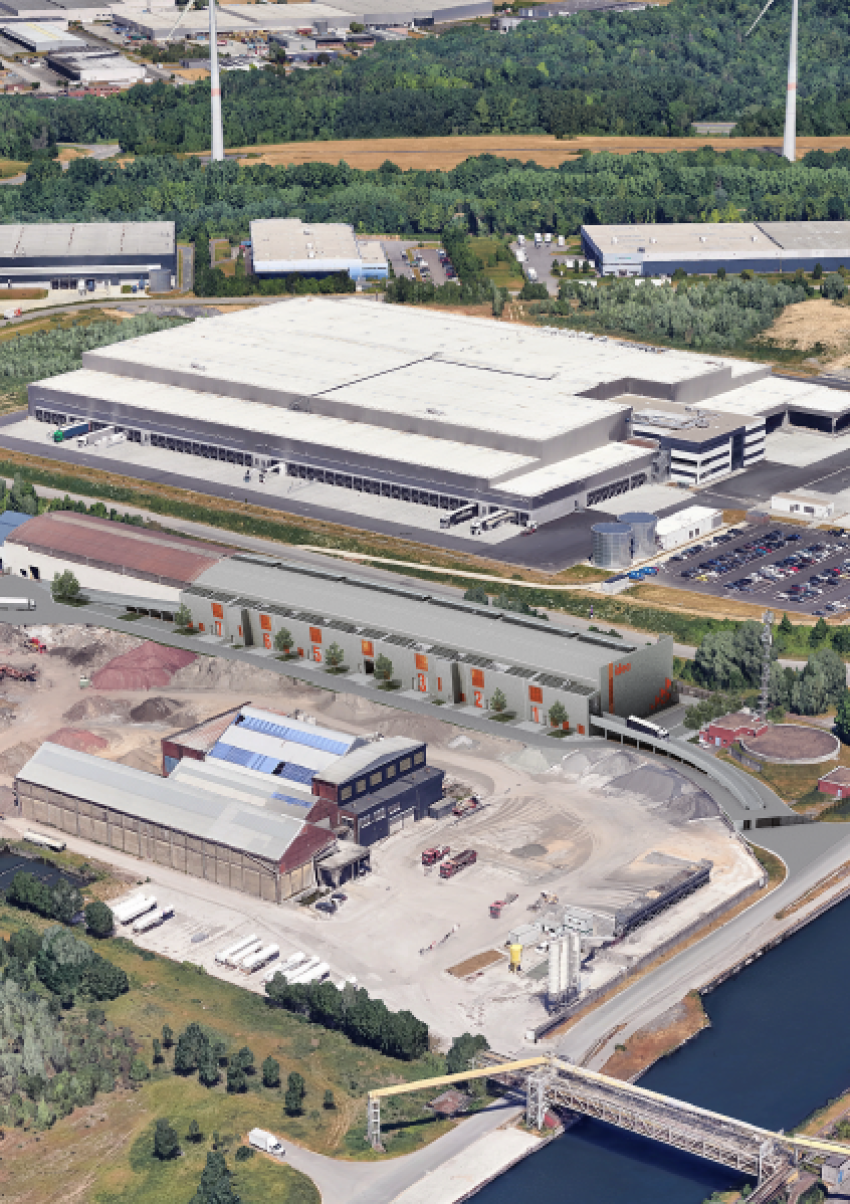
Among the projects presented by IDEA at MIPIM is the redevelopment of the Glaverbel relay hall. Supported by the European Regional Development Fund (ERDF), the project concerns the redevelopment of a 9,000 m² site in La Louvière — a former glass manufacturing plant — located next to Garocentre, a multimodal logistics park in the heart of Hainaut and close to a wind farm. A first conversion of the site took place in the 1980s, and today IDEA aims to build a new vertical zoning area based on the existing structure. The redevelopment project plans to redesign the building envelope to better align with current urban planning standards and improve insulation to meet climate challenges.
The aim is to host, by 2027, SMEs active in eco-circularity that will integrate into the innovation-driven “Heart for Cleantech” ecosystem. The project is currently in the permit application phase.
The MC² Cleantech project in Tournai

Also present at MIPIM, IDETA presented the MC² Cleantech Park project, which involves the rehabilitation of the industrial brownfield site of the former Ateliers Louis Carton in Tournai, to be converted into an economic activity hub dedicated to the circular economy. A direct neighbour of the CTP (International Technological Centre for Earth and Stone), the future MC² Cleantech Park will become the flagship site of the MC² Mineral Circular Center ecosystem. It will host start-ups and SMEs developing projects related to the circular use of mineral materials and new materials.
The former boiler-making workshops of ALC will accommodate an innovation centre, shared workshops, relay halls and social spaces. With a total surface area of more than 13,000 m² and ceiling heights ranging from 10 to 14 metres, the buildings offer significant potential for reuse. Within a circular approach, the existing structures will be rehabilitated as far as possible. Iconic elements of the site’s industrial heritage will be highlighted as identity markers, while construction choices will prioritise circular and, where appropriate, recycled materials.
Respecting the existing volumes and providing high-quality landscaping will help integrate the site into its natural and urban environment at the entrance to the city of Tournai.
Isabelle Anneet (AWEX)