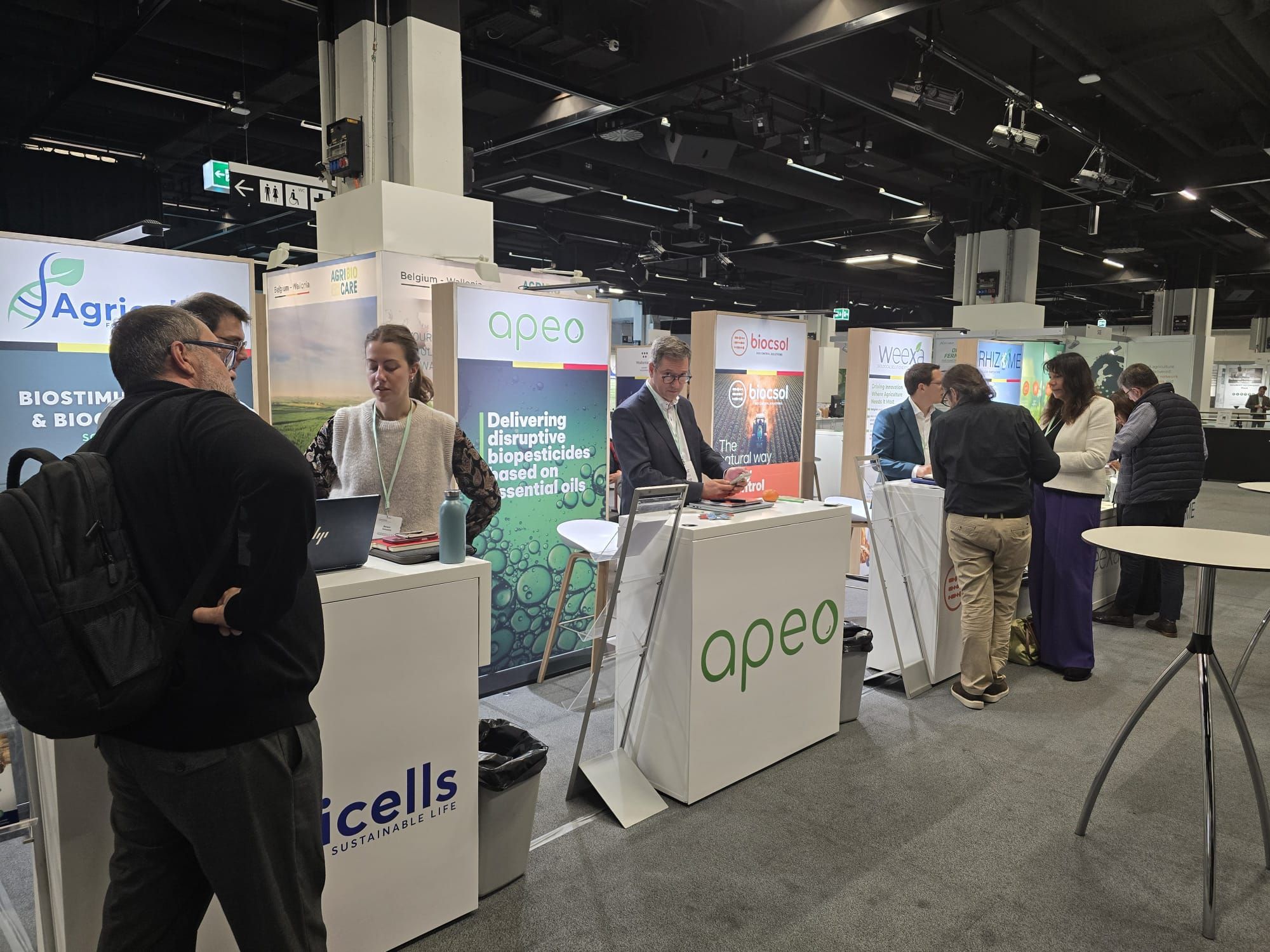
The ABIM (Annual Biocontrol Industries Meeting), the major international gathering of the biocontrol industry in Basel, Switzerland, attracted strong participation from Walloon stakeholders in the sector. Fungi, essential oils, and bio-based molecules: their innovations promise to reduce dependence on conventional pesticides. Throughout the exhibition halls, researchers met industrial players, distributors connected with start-ups, and investors assessed a rapidly evolving sector. The challenge? Finding ways to protect or enhance crops while reducing reliance on conventional plant protection products.
This year, around a dozen Walloon companies took part in the event, eight of them as co-exhibitors within a collective initiative led by Wagralim, Wallonia’s agri-food competitiveness cluster, with the support of the Wallonia Export & Investment Agency (AWEX). Behind these companies lies a common objective: transforming scientific discoveries into practical solutions for farmers and then expanding into international markets.
“Companies lacked the resources to promote themselves individually abroad,” explains Yuan Chai, International & European Affairs Manager at Wagralim. “Launched more than five years ago, this collective initiative enables participants to share costs, gain visibility, and build relationships with key partners.”
In this sector, however, a promising innovation is not enough. Companies must prove effectiveness, obtain the necessary authorizations, and secure the means to produce and commercialize their solutions on a large scale.
Fungi to Trigger Plants’ Natural Defences
Among the players in this ecosystem, KitoZyme, a company based in Herstal, had its own stand at ABIM. Founded 25 years ago, the company develops solutions based on chitosan, a biopolymer generally extracted from crustacean shells. KitoZyme’s compound, however, is produced from fungi (Aspergillus niger).
“Chitosan is multifunctional. Everything depends on how it is used, when it is applied, and at what dose,” explains Guillaume Deleixhe, Head of Agricultural and Oenological Activities at the company.
“In agriculture, this substance stimulates the plant’s natural defence mechanisms,” he adds. “Rather than focusing solely on destroying a pathogen, we help the plant defend itself more effectively.”
In viticulture, the company’s commercial solutions are notably used against powdery mildew and can also contribute to controlling downy mildew and botrytis, three diseases well known to winegrowers. They may also help reduce certain conventional treatments, particularly copper-based products.
Guillaume Deleixhe stresses one key point:“Biocontrol does not mean systematically replacing a canister of synthetic chemical product with a canister of biological origin. When facing a problem, several measures often need to be implemented, and biocontrol solutions are part of the toolbox.”
More frequent field monitoring, anticipating disease outbreaks, choosing the right timing for intervention, and combining multiple methods all require changes in farming practices. Such a transition takes time, support, and new knowledge.
Essential Oils Against Unwanted Weeds
Another Walloon company attracting attention, and another scientific avenue, is Apeo, a young company emerging from research conducted at Gembloux (University of Liège). Founded in January 2021, it develops bio-based herbicides derived from essential oils.
“We discovered that certain essential oils are extremely toxic to plants. That led to the idea of developing herbicides,” explains Haïssam Jijakli, the Gembloux Agro-Bio Tech professor behind the project.
The formulations developed are 100% natural and bio-based. Their mode of action is that of a non-selective contact herbicide. They can destroy many plants, including dandelions, nettles, and thistles. Unlike glyphosate, however, the bio-based product does not migrate to the roots. It must therefore be applied to young plants before underground reserves allow them to regrow. Another distinctive feature is its rapid degradation, with a reported half-life of 24 hours, potentially even shorter under certain conditions.
For Apeo, the first target market is home gardening. Authorization applications were submitted in Europe and the United States in July 2024, with the objective of obtaining European approval within the coming years.
This example illustrates one of the challenges faced by biosolution start-ups: an innovation may be scientifically promising without being immediately available to end users.
Preparing Crops for Drought
The ambition of Fyteko, a Belgian company founded in 2014 and headquartered in Louvain-la-Neuve, with a production facility in Mons, is to strengthen crops’ natural capacity to withstand difficult climatic conditions.
Its technology is based on a molecule derived from wheat endocarp, a co-product of wheat processing, transformed through green chemistry. Applied to plants, it activates protective mechanisms against water stress and high temperatures. The goal is to prepare crops before drought and heat waves occur.
“We start with bio-based monomers extracted from plants, which we transform to recreate new molecules that have biological activity in plants,” explains Guillaume Wégria, CEO and co-founder of the company.
Fyteko markets, among other products, a treatment applied directly to young shoots. The concentration of the product, which is diluted before use, means that only a few grams of active ingredient are required per hectare.
To accelerate its growth, Fyteko is preparing a collaboration with Certis Belchim, a European distributor of crop protection products and biosolutions. The aim is to leverage its commercial network and local expertise to facilitate access to new markets.
Is Europe Falling Behind the Pace of Innovation?
These companies are part of a broader international trend. Across Europe, biocontrol is gradually gaining importance within integrated crop protection strategies, which combine prevention, monitoring, and various control methods. The goal is not necessarily to eliminate all conventional pesticides, but rather to diversify available tools and reduce their use whenever effective alternatives exist.
However, market development continues to face a major obstacle: lengthy authorization procedures. In Europe, active substances and plant protection products are subject to a strict regulatory framework designed to protect human health and the environment. Applications must provide sufficient scientific evidence regarding both effectiveness and risks. While essential, these procedures can become especially burdensome for small companies.
“The main obstacle to development remains product registration,” confirms Guillaume Deleixhe of KitoZyme.
For some active substances, approval timelines can reach ten to fifteen years. The process requires costly studies and substantial financial resources, while companies must continue funding research and preparing future production capacities.
The case of Biocsol, a spin-off from UCLouvain, illustrates this long-term challenge. The company works on metabolites produced by micro-organisms to combat diseases such as potato late blight. Rather than applying the micro-organisms directly, it recovers the substances they produce through precision fermentation.
Founded at the end of 2023, Biocsol raised €10 million at the end of 2024 to continue developing its solutions. Its first European regulatory submissions are expected between late 2027 and mid-2028. If current timelines remain unchanged, commercialization within the European Union could occur around 2034-2035.
In response, the European “Omnibus” initiative is considering measures to accelerate approval procedures for biocontrol products. Proposed options include priority treatment of applications, provisional authorizations following an initial national assessment, and a simplified approach to facilitate approvals across different EU zones.
The stated objective is to reduce certain approval timelines to three or four years, or even less in some cases. However, this remains a proposed reform rather than a guarantee that all products will reach the market more quickly. Scientific safety requirements, after all, remain central to the process.
By Christian Du Brulle, Daily Science