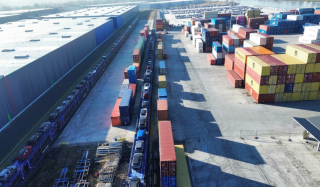
Liège Airport posted an exceptional performance in 2025, with cargo volumes up 14% compared with 2024, reaching 1,324,579 tonnes. This represents the strongest growth among Europe’s ten largest air cargo airports. Aircraft movements also increased, with 28,822 cargo flights recorded in its core business (+6%).
Liège Airport, the 5th largest cargo airport in Europe, number one in Belgium and among the world’s leading cargo hubs, is the only European airport to prioritise full cargo operations (#freightersfirst). It specialises in the transport of perishables, pharmaceuticals, express parcels, e-commerce, medical and humanitarian supplies, as well as live animals.
In 2025, the total number of aircraft movements reached 36,979 (stable compared with 37,029 in 2024). Cargo aircraft continue to dominate, with 28,822 movements, representing a 6% increase compared with 2024 (27,184 movements). The distribution between daytime flights (65.5%) and night flights (34.5%) confirms the shift underway over the past four years (in 2020, night flights still accounted for 59%).
Liège Airport handled 1,324,579 tonnes of cargo (versus 1,162,935 tonnes in 2024), the second-best result in the airport’s history. Over the past ten years, cargo volumes have more than doubled.
“The performance is very strong, as growth over the past two years exceeds 30%. Our largest customer represents 13% of the volumes handled, the second 10%, and the third and fourth 9% each. This balanced distribution makes our airport resilient,” explains Laurent Jossart, CEO of Liège Airport. “The diversification of our airline portfolio continues, with 56 airline customers at the end of 2025 compared with 40 at the end of 2023. The same applies to logistics companies, with an even more marked increase: 62 operators in 2025 versus 37 in 2023. Our goal is to reach the podium of European cargo airports and to consolidate our positioning as a provider of sustainable and multimodal logistics solutions. This strategy has strengthened the airport’s economic hub, with several hundred direct and indirect jobs created over the past two years.”
Confirming the airport’s key role in international logistics, new destinations have been added to the network: Bogotá, São Paulo, Mexico City, Chicago O’Hare, Oakland, Toronto Hamilton, Nanjing, Chongqing, Mumbai, Taipei and Ostrava.
However, there is no room for euphoria, as 2026 is set to bring major challenges: “We will face significant challenges, including a European tax on e-commerce parcels coming into force on 1 July 2026, which could strongly impact this segment of air freight, as well as a tense and volatile geopolitical situation directly affecting supply chains, and issues related to electrical capacity to equip the economic zones around the airport. Caution and further diversification will therefore be essential. As a result, we will focus on growing our volumes in the pharmaceutical, perishable goods and high-tech sectors.”
In terms of passenger transport, Liège Airport recorded a decrease of 14.5%, with 138,352 passengers (versus 161,936 in 2024). “This will be a challenge for 2026, as following the suspension of TUI’s operations at the beginning of 2026, we no longer have regular destinations to offer. Passenger transport represents barely 1.5% of our revenues and is not a financial issue for Liège Airport. However, it is a service to the residents of the Province of Liège that we care deeply about, and our commercial team is working on it,” Laurent Jossart concludes in a press release.
Isabelle Anneet (AWEX)
Linked articles
Related articles

Kersia Belgium is positioning itself as an international hub for food safety

Wallonia, a Hub for Innovation in Agricultural Biosolutions

EHP Accelerates Its Growth with a New Manufacturing Facility and a Strategic Partnership for Ariane 6