From Energy Dependence to Green Power: There’s Only One… Liégeois!
Wallonia already has a scholar envisioning the city of tomorrow…
There are moments when climate change ceases to be a scientific projection and becomes an everyday experience.
Heat that settles in and becomes difficult to bear. Soil that dries out. Fires that draw closer. Rain that, conversely, can turn a stream into a threat within minutes. Neighbourhoods that are not all equally exposed, populations that do not all have the same resources to adapt and, perhaps tomorrow, much more serious consequences for our agriculture and food supply.
For Junior Mbangala, a 28-year-old economist from Liège, this climate reality did not emerge solely from books or lecture theatres. It burst into his life in 2021, when devastating floods struck Belgium.
Chênée is home to him.
He enjoys walking around the neighbourhoods, following the paths designed for walkers and admiring this part of the city, which he finds so beautiful. Then, suddenly and without warning, nature unleashed its fury. Water flooded the streets, destroyed homes and turned lives upside down. Junior recounts witnessing and experiencing the horror, suffering of indescribable intensity, and the despair and distress of so many residents of his community.
It was as though a bomb had struck the landscape, leaving destroyed homes and memories in its wake.
This experience was a real wake-up call.
It transformed an intellectual question into an existential one: how can we prevent such disasters? How can we make our regions more resilient? How can we ensure that the ecological transition is not merely a matter of technology or figures, but a genuine transformation of the way we live?
It was from this point onwards that Junior decided to devote part of his thinking to disaster prevention and, more broadly, to the way we will inhabit our cities and regions in the future.
A Young Economist Who Wanted to Understand the World
At 28, passionate about ecology, economics and people, Junior Mbangala had nevertheless dreamed of becoming a journalist.
His driving force was already there: understanding mechanisms and how things work. How does it work? Why?
Having earned a Master’s degree in Economics and Public Policy, he gradually began to forge an intellectual path extending far beyond the boundaries of any single discipline.
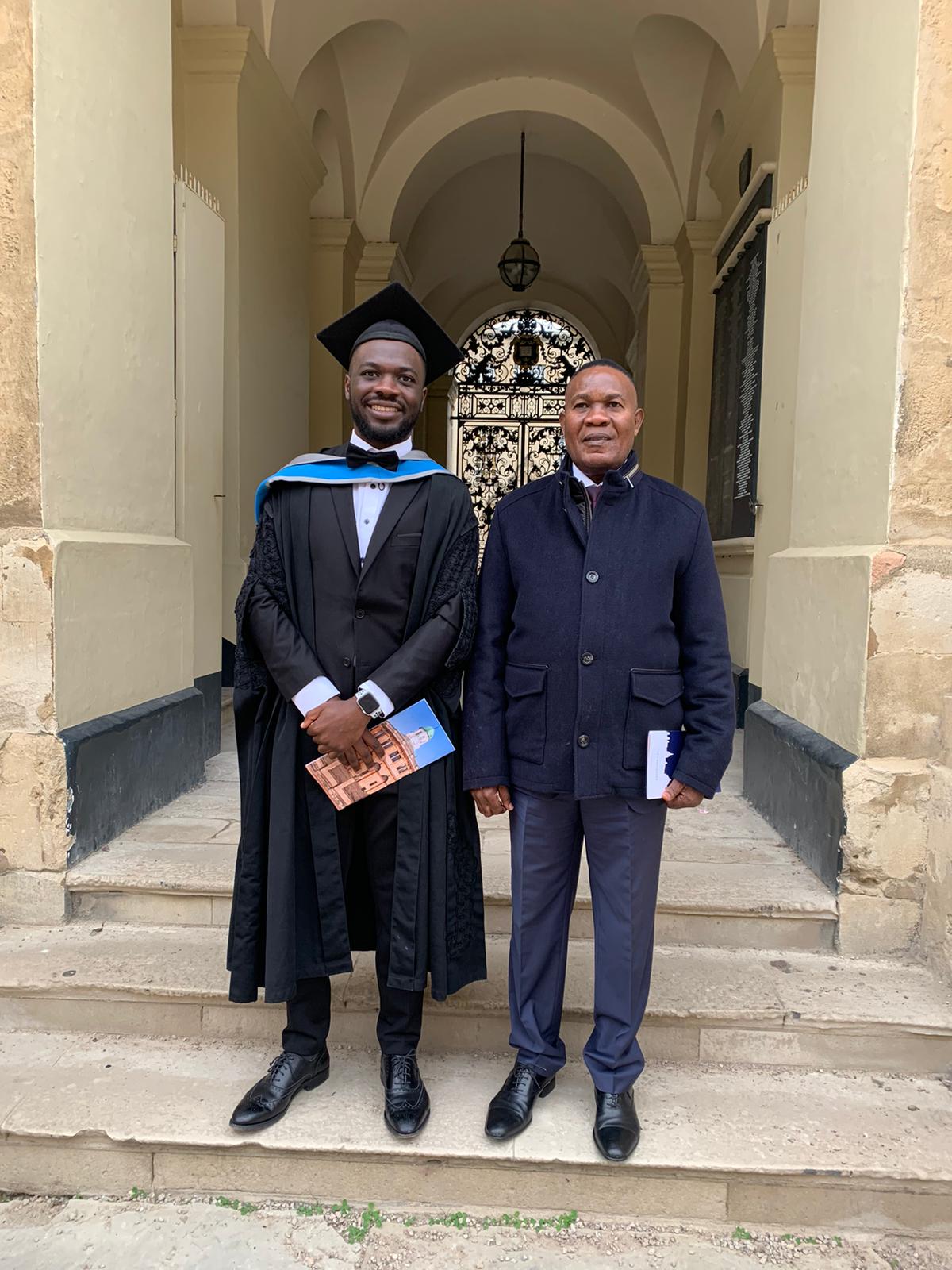
While studying at the University of Oxford, an idea began to take shape: to imagine a new paradigm capable of linking the economics of human and social development with energy independence, while making respectful use of nature’s resources.
For Junior, the ecological crisis cannot be separated from social injustices or the power dynamics that run through our societies.
Behind the energy transition, therefore, lies much more than solar panels, renovated buildings or emissions-reduction targets.
There are citizens.
Neighbourhoods.
Power dynamics.
Inequalities.
Collective choices.
And a fundamental question: who participates in transforming our regions, and who benefits from that transformation?
A Different Way of Looking at Energy
In his research on Wallonia, Junior Mbangala focuses in particular on energy justice and policies relating to solar photovoltaics.
At first glance, the issue might seem purely technical.
It is not.
Who can install solar panels? Who can invest? Who benefits from support schemes? Who can participate in new energy communities? What happens to households that cannot afford to finance their own transition?
Generating renewable energy is one thing.
Ensuring that this energy contributes to a more equitable society is quite another.
It is this second question that interests Junior.
It becomes particularly important when we realise that the energy transition can also be developed at the level of a neighbourhood, a school, an apartment building or a municipality.
Can we imagine a school that produces more solar electricity than it consumes at certain times of the day?
Why should this energy, generated from a free natural resource, not benefit other local residents or public buildings whenever production allows?
Behind this very tangible possibility lies a different vision of the city: one in which energy does not flow solely from large power stations to anonymous consumers, but can also be produced, shared and managed locally.
The City as an Actor in the Transition
This is where Junior’s thinking becomes particularly interesting for Walloon municipalities.
We often tend to view the ecological transition as a succession of decisions made at national or regional level.
Yet climate change is experienced in specific places, such as:
On a street.
In a school.
In an apartment building.
In a business.
In a home.
In a neighbourhood.
In a municipality.
In a field.
In an orchard.
Solutions can emerge at this level, too.
Junior is particularly interested in energy communities and forms of local cooperation that can bring energy production and consumption closer together.
And he goes further—much further.
He is not interested solely in the energy that flows. He is also interested in the relationships that develop around it.
Citizens, public authorities, businesses, associations, institutions and researchers: all these stakeholders can become part of the same local ecosystem.
It is no longer simply a matter of asking citizens to “do their bit”.
It is about enabling them to become active participants in transforming their own region.
Thinking of the Transition as a Rhizome
A particularly powerful image emerges from this line of thinking: that of the rhizome.
A rhizome does not necessarily grow from a single centre. It spreads in several directions, creates connections and establishes new links.
This metaphor offers a different way of imagining the energy transition.
Rather than an entirely top-down system, in which decisions flow from an authority to the local area, Junior envisages a network of initiatives connected to one another.
A municipality.
A school.
A group of citizens.
An association.
Social housing.
A local business.
A renewable energy producer.
Each can become a point of connection.
The city of tomorrow could thus function more like a living organism than a centralised mechanism.
But Junior immediately adds an essential nuance to this vision: a network is truly fair only if it allows everyone to participate.
A transition that benefits only those who already have financial resources, technical knowledge or privileged access to decision-making risks reproducing the very inequalities it claims to combat.
Junior therefore raises an essential question: who participates in this transformation, and who benefits from it?
Wallonia Seen from Oxford
There is something distinctive about Junior Mbangala’s journey.
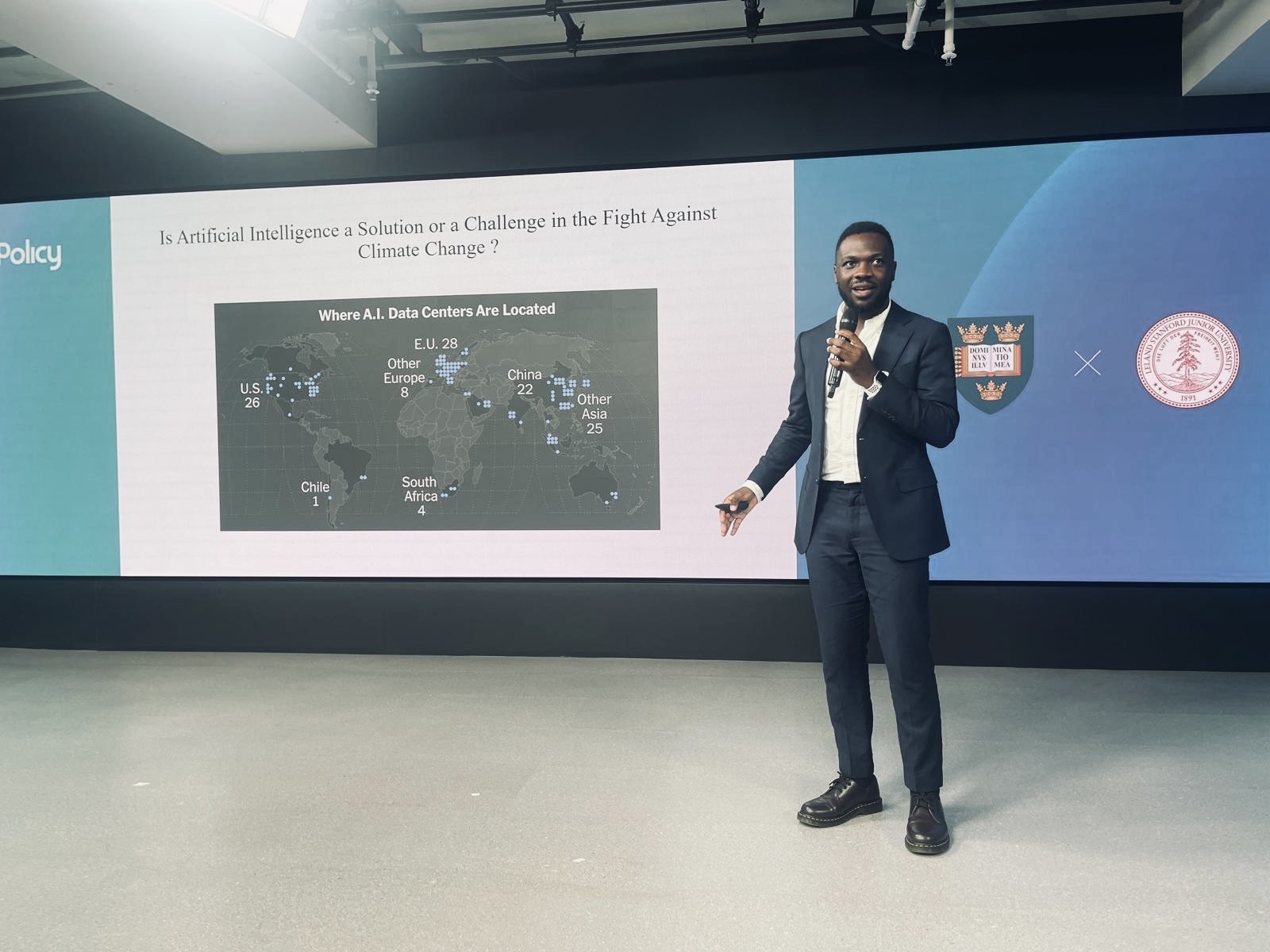
He works on these issues in an international academic environment, notably at Oxford. He has also gained experience at the Wallonia-Brussels Delegation in London and continued his career at the Permanent Representation of Belgium to the United Nations in New York.
His journey could almost be summed up in a single sentence: he studied these issues at the University of Oxford, observed them on the ground and went to see how they are negotiated at international level.
Yet his profoundly humanistic perspective has not become detached from Wallonia.
On the contrary.
He seems to have chosen to look at it from a broader perspective.
This may be one of the most valuable contributions of researchers who move between different worlds: they return with questions that we do not always ask ourselves when we remain confined within our administrative boundaries.
What could Wallonia become if it regarded its cities as laboratories for the transition?
What could we do with our public buildings?
Our schools?
Our neighbourhoods?
Our rooftops?
Our urban spaces?
Our communities?
Our fields and agricultural land?
And above all, how can we turn the energy transition into more than a regulatory obligation and make it a collective project?
From Floods to a New Way of Thinking About the Future
For Junior, the floods of 2021 were much more than a natural disaster.
They exposed a vulnerability that had previously often been discussed through concepts, statistics and projections.
Climate change was no longer an abstraction. It was there.
This personal experience gives his work a particular dimension.
Behind the concepts of energy transition, urban resilience and climate justice lies a lived reality.
And perhaps that is precisely what we need today: to bridge the gap between science and everyday life.
The Question Wallonia Should Be Asking Itself
Junior Mbangala’s journey raises a question that goes far beyond his own circumstances.
Does Wallonia do enough to recognise and retain the people capable of shaping its future?
At a time when municipalities must simultaneously address climate change, energy poverty, changing patterns of mobility, building renovation and the need to make our regions more resilient, do we need further climate disasters before we connect these challenges and implement the ideas put forward by scholars such as Junior Mbangala?
Our administrations and local authorities already employ engineers, urban planners, architects, environmental specialists and project managers.
We also need people capable of bringing energy, urban planning, climate, social justice, citizen participation, research and international issues into dialogue with one another.
Do our municipalities and institutions have people capable of thinking about energy, urban planning, climate, social justice and international issues simultaneously?
And If Not, Another Question Deserves to Be Asked
Will we need to create new roles in the future for these new thinkers on regional development?
Why wait until a situation becomes urgent when we have been experiencing natural disasters and climate-related emergencies for several years?
It is always easier to react once disaster has struck.
But a truly ecological policy should perhaps work differently.
It should anticipate.
Junior Mbangala is not simply proposing to repair the existing model.
He invites us to reflect on what the next model could look like.
And this reflection deserves to be heard far beyond university walls.
From Wallonia to the World—and from the World to Wallonia
There is, finally, an intriguing irony in this story.
Although Junior has continued his career in New York, at the heart of an institution where nations meet to discuss major global challenges, the issues he addresses remain deeply rooted in local realities.
The ecological transition is global, but it is built locally.
The United Nations can set targets.
States can adopt strategies.
Regions can enact policies.
But ultimately, the transition takes shape somewhere: in a city, a neighbourhood, a school, a business—or simply in the everyday lives of citizens.
Perhaps that is where the true strength of Junior Mbangala’s thinking lies: in connecting the world with the local region.
Looking at Wallonia from Oxford.
Looking at Walloon issues from London.
Taking these ideas all the way to New York.
And perhaps tomorrow, bringing back to Wallonia what has been learned elsewhere.
What If We Started Thinking Differently?
We have entered a period in which the climate no longer asks us whether we want to change.
It forces us to think about how we are going to live.
The question is therefore no longer simply how many tonnes of CO₂ we need to cut or how many photovoltaic panels we need to install.
The question runs much deeper:
What kind of city do we want to live in?
What kind of region do we want to pass on to future generations?
What Role Do We Want Citizens to Play in This Transformation?
Junior Mbangala brings a fresh, international perspective to these questions, one that remains deeply rooted in local realities.
His journey began with a desire to understand the world, followed by a profound personal experience in his own community. From the streets of Chênée to the lecture halls of Oxford, from London to New York, his path has led him to see the issues unfolding on our doorstep in a different light.
It would be a shame to wait until a crisis forces us to seek out those who are already thinking about what comes next.
Our regions need people capable of shaping the future before it is forced upon us.
What if Wallonia chose to listen to Mr Mbangala?
Contact Junior Mbangala
Email: junior.mbangala@kellogg.ox.ac.uk
LinkedIn: www.linkedin.com/in/juniormbangala
Victoria B. Lohay
Wallonia.be Ambassador
CTA
Sign up
Complete the application form and adhere to the Charter of Brand Ambassadors