When Openness Becomes a Strength
An artists’ trail as a source of economic renewal…
Most artists’ trails introduce a town to its own residents, while others tell a broader story: a way of conceiving creativity, a way of inhabiting a place and, undoubtedly, a particular vision of the future.
A few words immediately catch my attention: “Artists and Craftspeople of Malmedy and Elsewhere”.
These three words — “and”, “of” and “elsewhere” — might be no more than a formula were it not for the history of the AAMA, conceived and founded in 1984.
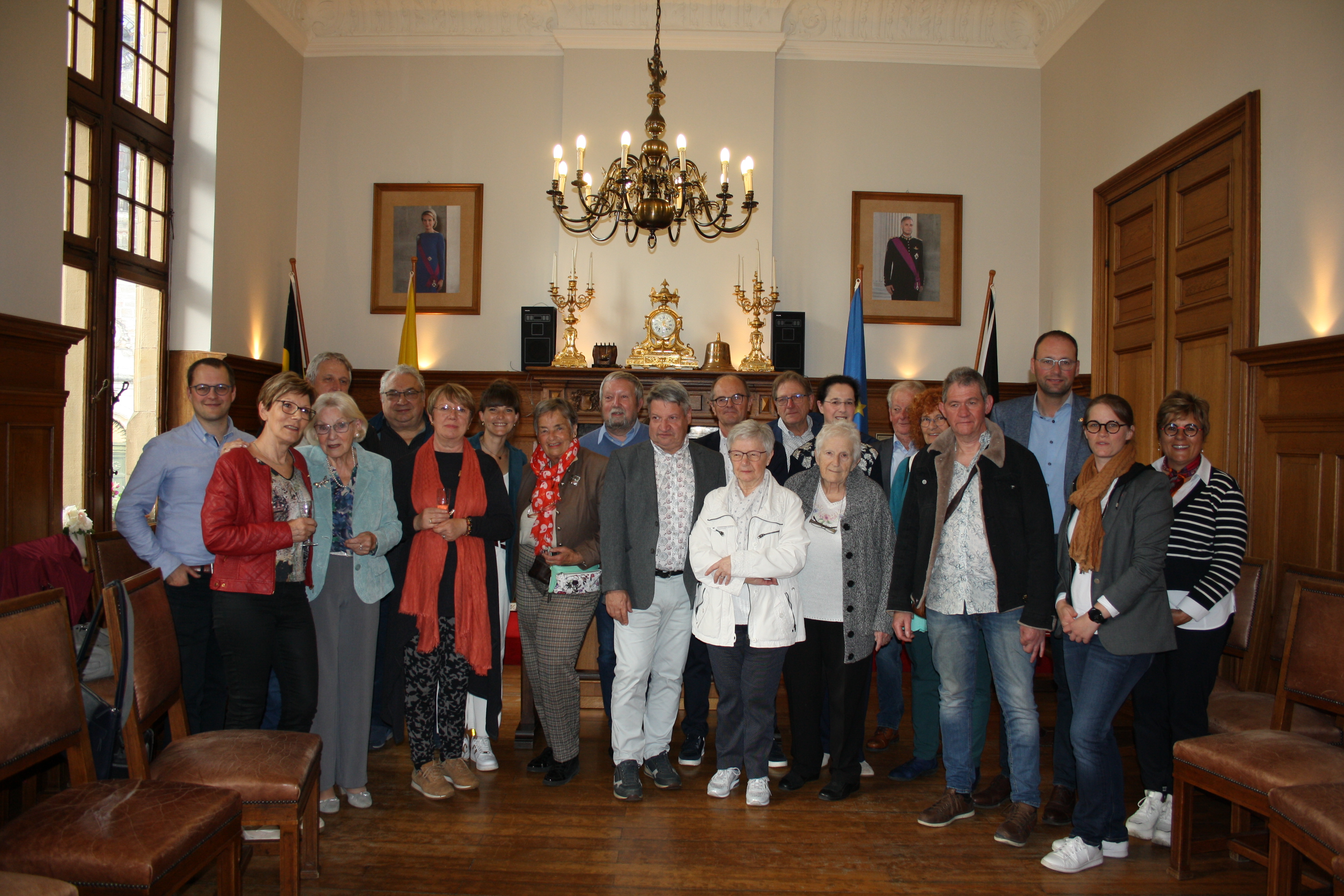
The AAMA is a non-profit organisation whose name stands for “Artists and Craftspeople of Malmedy and Elsewhere”. It is expertly run by a dynamic and friendly team.
Welcoming artists and craftspeople from elsewhere is nothing new for this association. It is an approach rooted in openness that has been part of its identity for almost forty years.
This longevity changes the way we view the AAMA’s activities. Over the years, the association has gained experience, developed its practices, established ways of organising and promoting artistic events, and learned how to bring together people from different backgrounds and fields.
What we might today describe as openness or innovation is, in reality, the result of long-standing experience and maturity. This achievement deserves our attention.
A town confident enough to welcome elsewhere
Welcoming someone from elsewhere is no trivial matter. It means accepting that a “stranger” enters one’s territory bringing something of themselves: a different perspective, a different journey, different techniques and sensibilities, a different history, and a different way of looking at and experiencing the world.
A town may choose to protect its identity by closing itself off. But it can also consider its identity strong enough to welcome other perspectives without feeling threatened.
It is this second approach that makes the AAMA’s way of working particularly interesting.
Artists from elsewhere in no way replace Malmedy’s own artists. On the contrary, they meet and engage with them.
This distinction is essential.
Malmedy’s local identity is not a boundary; it is an invitation to encounter others.
A town that is confident enough to decide whom and what it can welcome is a town that has nothing to fear.
It can even enrich and rediscover its own identity through the eyes of those who are discovering it.
This is perhaps one of the most interesting forms of cultural maturity.
Forty-two years is no longer a period of experimentation!
The AAMA has been in existence since 1984!
More than forty years of existence lend a particular depth to its activities. It would be easy to talk about novelty, innovation or experimentation, but Malmedy has moved beyond all that.
An organisation that has spent several decades organising, promoting and developing artistic events has accumulated a wealth of knowledge. It:
-
knows the artists, the audiences and the venues;
-
knows how to mobilise different stakeholders;
-
knows how to circulate information;
-
knows how to organise an event;
-
and, above all, knows how to create the right conditions for people to meet.
Maturity means taking risks and taking action.
It can enable an organisation to continue evolving without losing sight of the purpose of what it does.
And this is where the idea of the avant-garde takes on a particular meaning.
Being avant-garde in this context suggests that Malmedy understood early on that a different way of thinking about a territory would, over time, become particularly relevant.
Art does not remain confined within four walls
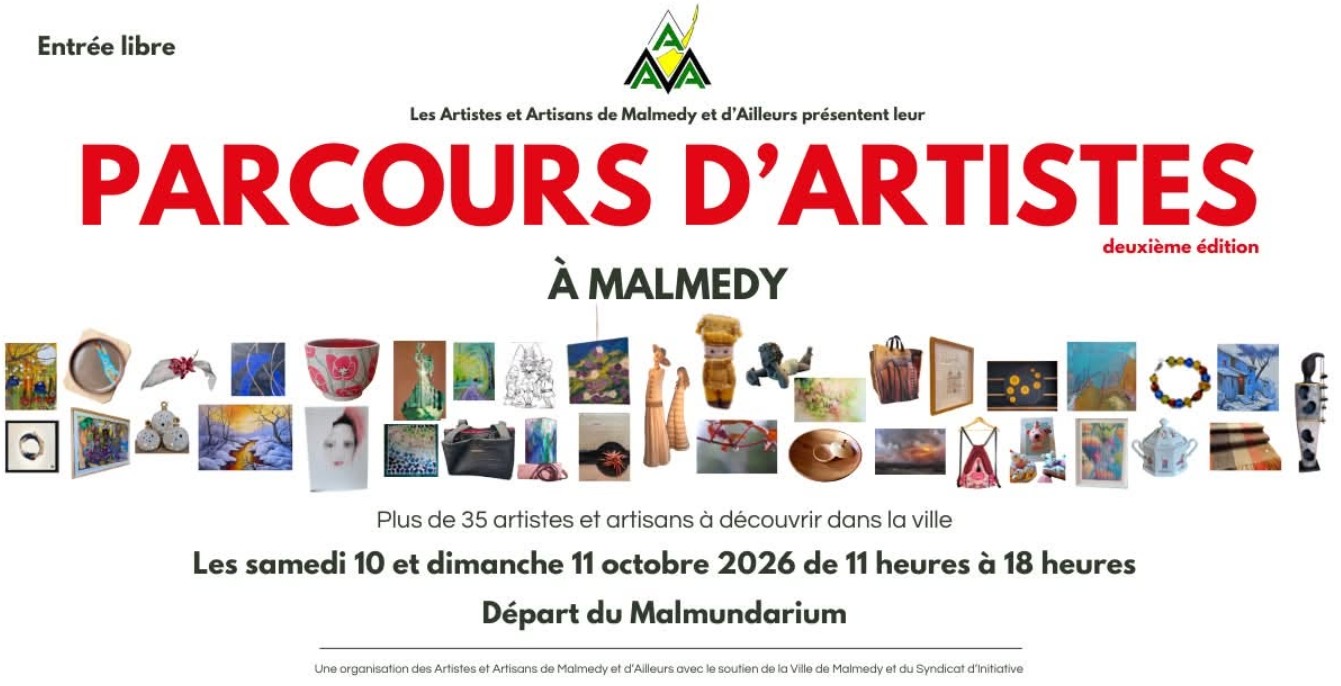
The way creativity permeates the town is also striking during the artists’ trail organised by the AAMA in Malmedy, Belgium, on 10 and 11 October 2026.
Churches, chapels, shops, businesses, private homes and other venues become spaces for encounters with art for the duration of the trail.
A shop becomes an artistic venue; a house becomes an exhibition space. A business takes part in cultural life. A heritage site welcomes creative works. The town itself becomes the setting for the trail.
Visitors do not simply move from one exhibition to another. They travel through a territory. As they make their way through it in search of art, they also discover its places in a new light.
The movement works both ways.
Those who come for the art discover a shop, a business, a neighbourhood or a heritage site.
An artist from elsewhere discovers Malmedy. A resident of Malmedy gets to know an artist from elsewhere.
Art thus becomes a means of bringing perspectives and energies into circulation.
What research is observing today
This approach connects with questions that are currently attracting the attention of academic researchers studying territories.
A study by Natalia Bobadilla, Marie Göransson and François Pichault, involving researchers affiliated with the University of Liège (ULiège) and the Université libre de Bruxelles (ULB), examines the conditions under which artistic interventions can contribute to urban regeneration.
The researchers are particularly interested in the ability of these projects to mobilise different stakeholders — artists, public authorities, citizens and others — and to forge connections between worlds that might not otherwise intersect.
Their research shows that when this work of building connections is pursued consistently over time, artistic interventions can have a significant impact on urban regeneration.
This is not to claim that the AAMA’s work, on its own, constitutes scientific proof of this theory. However, the events it organises offer a concrete illustration of some of the mechanisms being studied.
The AAMA brings together:
-
artists and craftspeople;
-
artists from Malmedy and artists from elsewhere;
-
residents and creators;
-
shops and art;
-
businesses and artists;
-
heritage and creativity;
-
visitors and the town’s venues.
Art is therefore no longer merely something to be displayed. It becomes a vehicle for human connections.
When culture contributes to a territory’s dynamism
This issue extends far beyond the artistic sphere.
Research into the cultural and creative industries shows that culture can contribute to a territory’s identity, attractiveness and economic revitalisation. ULiège highlights, in particular, the increasingly hybrid nature of these activities and their ability to build bridges with other sectors of the economy.
Research conducted at ULiège has also examined how culture can be integrated into an economic revitalisation strategy in a city affected by deindustrialisation, using Liège as a case study.
This does not, of course, mean that art is a magic formula for economic success. A town does not become prosperous simply because it organises cultural events.
The relationship is more complex. Creative activity can help foster encounters, collaborations, new connections, new ways of looking at a territory and, sometimes, new activities.
It can contribute to a process of renewal.
This capacity for renewal is particularly important when a territory is going through a difficult period.
A thriving town is also one that knows how to renew itself
A town is never built once and for all. It evolves and experiences periods of prosperity, difficulties, economic transformations and social change.
When a crisis strikes, the question is not simply how to return to the previous situation.
Sometimes, we need to imagine what comes next.
This is where artistic creation possesses a particular power.
A work of art emerges from something that already exists — a material, a story, a place, an emotion — but transforms it.
Why should a town not also be able to transform what it already has in order to create new possibilities?
It has heritage, shops, businesses, craftspeople, artists, residents, organisations, practical skills and interpersonal skills.
And when these elements come together, new things can emerge.
Renewing a territory does not necessarily mean erasing its past. It also means transforming its heritage into a resource for the future.
Maturity as the capacity for openness
This is where the concept of maturity comes into its own.
A mature town is perhaps not one that already has all the answers.
It is one that recognises it does not have all the answers and is therefore willing to look beyond its own boundaries, draw on its local strengths and allow new influences to enter.
This attitude requires a certain degree of confidence.
One must feel sufficiently connected to one’s territory not to fear encounters with the outside world.
And perhaps this is precisely what gives openness its value.
Openness is not necessarily a weakness of identity. Rather, it is a sign that this identity is strong enough to evolve.
“Malmedy and Elsewhere”
These words deserve careful consideration: Malmedy and Elsewhere.
“Elsewhere” is not presented as an exception, since it forms part of the association’s very name.
It is a declaration of intent!
This means that local art can engage in dialogue with other territories and sectors; that artists from Malmedy can meet other artists; that craftspeople can exchange knowledge and skills with others; and that the public can discover different sensibilities.
It also means that Malmedy itself can be seen through the eyes of those who come from elsewhere.
Local identity is no longer conceived as a closed enclosure.
It becomes a place of exchange.
An open territory.
The elegance of an open town
Finally, there is a dimension that figures and studies cannot fully measure.
Elegance.
Art does not reside solely in the creation of a work. It also exists in the quality of the welcome.
Elegance is also a way of looking at things and making room for others.
In art, as in a town, it can be the ability to affirm who we are without needing to shut the door on what comes from elsewhere.
An elegant town is not necessarily a spectacular one.
And this kind of elegance is not superficial. It is a genuine force for renewal.
A year in which words take on a new meaning
In 2026, this reflection takes on a very special significance.
Malmedy and the entire Hautes Fagnes region are currently facing a crisis of exceptional severity. The population is in mourning.
As I write this article, the fire ravaging the Fagnes — the exceptional natural landscape of the Hautes Fagnes, cherished by everyone in the region — has already affected nearly 4,000 hectares. Residents have had to be evacuated, and the ecological, human and territorial consequences of this disaster will take a long time to assess.
Behind the burnt hectares lie:
-
a territory unique in the world;
-
breathtaking landscapes;
-
animals, some of which have become rare;
-
exceptional flora;
-
natural habitats;
-
activities carried out with respect for the environment;
-
businesses;
-
jobs;
-
ways of life;
-
memories;
-
and, above all, women and men.
People who must now cope, protect, help, work, make decisions and adapt.
Some will have to rebuild. Others will have to reinvent their activities. Still others will simply have to find the strength to carry on.
This is an ecological, human, economic and social tragedy. Its consequences will undoubtedly be felt for a long time to come.
In such a context, the question of the region’s renewal becomes a necessity.
Rebuilding means moving forward
After a disaster, we naturally talk about reconstruction.
Rebuilding does not necessarily mean putting everything back exactly as it was.
-
Some balances may not be restored immediately, or perhaps ever.
-
Some landscapes will change.
-
Some activities will have to evolve.
-
Some habits will have to be reconsidered.
We will need to repair, protect and restore.
But we will also need to imagine. And this is where artistic creation can take on a particular significance.
Art will not restore the hectares of the Fagnes that have been lost. It will not, on its own, rebuild the economic activities that have been affected, nor will it make the pain disappear.
It can remind us of one essential thing: a wounded territory remains alive if it chooses to be.
Creating in the face of adversity is a way of affirming that the future still exists.
October 2026: a hymn to life
It is against this backdrop that the AAMA’s artists’ trail in October 2026 takes on a special resonance.
This year, it will be seen as more than just a cultural event. It will be a hymn to life, to hope and to renewal.
It will also be a way of honouring all those who, in these painful circumstances, continue to fight, protect, help, work, rebuild and create.
And there are those who simply carry on.
Art does not deny pain. It does not pretend that everything is fine. It does something else.
It affirms the possibility of continuing to create.
And creating when everything seems fragile is an act of hope.
Opening one’s doors when one might otherwise withdraw is an act of trust, hope and love for life.
Welcoming artists from elsewhere while going through a difficult time oneself is a way of saying that the world keeps turning.
Bringing together residents, artists, craftspeople, shops, businesses and visitors helps keep alive the collective capacity a territory needs when it has to get back on its feet.
An avant-garde that stands the test of time
Is the AAMA avant-garde?
The term may seem ambitious. But perhaps we simply need to redefine what we mean by “avant-garde”.
The avant-garde is not always what comes before everyone else. It can also be what, with sufficient maturity, continues to champion an idea before that idea becomes obvious to everyone.
Since 1985, the AAMA has been fostering an open approach to the artists’ trail.
It does not reduce art to a single place, the territory to its borders, or local identity to insularity. It encourages movement, forges connections, welcomes people and creates the conditions for encounters.
And this approach connects with questions that researchers are now exploring: how can art contribute to the renewal of territories? How can connections be forged between different stakeholders? How can cultural and creative activities contribute to a territory’s attractiveness and economic revitalisation?
The AAMA clearly did not wait for this research before taking action. That is precisely what makes its history so interesting.
“Malmedy and Elsewhere”
This year, when artists and craftspeople take over venues across Malmedy, the public will come to see carefully selected works.
But that is not all.
Visitors will also be able to observe something broader: a way of bringing a town to life and putting creativity into circulation.
A way of bringing together what usually remains separate.
A way of welcoming elsewhere without renouncing one’s own identity.
After forty-two years of existence, the AAMA is no longer simply experimenting with a model.
It has built up a body of experience, put it to the test, developed it further and continues to bring it to life.
Ultimately, the cultural maturity of a territory may lie in knowing who one is well enough not to fear what comes from elsewhere.
Is this what the avant-garde is all about? Not chasing novelty, but continuing to open doors when the world might sometimes be inclined to close them.
Continuing to create when the future seems uncertain.
Continuing to place our trust in encounters.
In October 2026, the AAMA’s artists’ trail will therefore take on a special significance. It will offer an opportunity to come together to observe, discover, create and hope.
A moment when art reminds us that, even after hardship, life continues to seek out new forms.
And perhaps this is, ultimately, the finest definition of a mature town: one that knows how to preserve what it loves, welcome what it does not yet know, and create, despite everything, what tomorrow will bring.
If you would like to experience the trail on 10 and 11 October 2026, please note that 267 guesthouses and several hotels in Malmedy will be available to accommodate visitors.
Contact the AAMA
Secretary: Emilie Gentgens
Chair: David Noël
Email: association.aama.4960@gmail.com
Artists and Craftspeople of Malmedy and Elsewhere | Facebook
Photos provided by David Noël
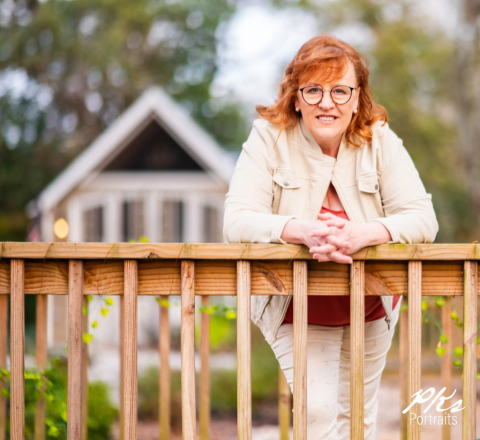
Victoria B. Lohay
Ambassador For Wallonia.be
CTA
Sign up
Complete the application form and adhere to the Charter of Brand Ambassadors