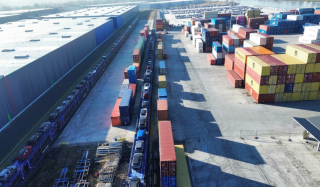
In just 25 years, the Autonomous Port of Centre and West has become Europe’s sixth-largest inland port. We met with its Director, Christelle Kozak, to learn more about its 174 km of sites along the waterway.
Are you familiar with the Autonomous Port of Centre and West? If you work in the logistics sector, you have probably already heard of it. It is the sixth-largest inland port in Europe. “With more than 7 million tonnes transshipped every year, we outperform inland ports such as Lille or Brussels. We have quite exceptional results for a young port, and we are growing,” says Christelle Kozak, Director of the Autonomous Port of Centre and West (PACO).
The Autonomous Port of Centre and West was founded in 1999. It comprises 174 km of sites along the waterway (out of the 450 km in Wallonia). PACO covers three territories—Hainaut, Wallonia Picarde and Mons-Borinage—and consists of 67 sites. “We therefore have a much larger territory than a port centred on a single city,” the Director points out.
“The main mission of the Autonomous Port of Centre and West is to develop and promote modal shift, which translates into the planning, management, operation and allocation of the port areas entrusted to us. Along the waterway, we look at land designated for port use. There are two types of sites: either waterfront land where we bring in an industrial or logistics activity, or industrial sites that have the potential for modal shift, where we assess whether it is possible to move them towards inland waterway transport,” explains Christelle Kozak.
The advantages of inland waterway transport
She acknowledges that modal shift via inland navigation still suffers from negative perceptions, but for Christelle Kozak it offers many advantages. “First, there is a clear economic benefit for companies. Then, the major advantage is decarbonisation. One barge replaces around thirty trucks on the roads. This has a direct impact on CO₂ emissions, as well as on noise levels and accident risks,” she explains.
PACO has also included environmental clauses in its selection of candidates, as well as social and circular economy criteria. “We pay close attention to ensuring that companies settling on our sites use as few trucks as possible and maximise modal shift. Road transport accounts for less than 5% of traffic on our sites,” adds Christelle Kozak.
Several sectors are represented at PACO. “We host companies in the petrochemical sector, logistics firms and quarry operators… But almost everything can be transported by inland waterway.”
And PACO continues to expand. “We have six terminals that will be completed over the next five years—one new terminal becoming operational each year. We also have a plan for 24 areas to be redeveloped or newly created. At the same time, there are many opportunities to further develop our activities using existing infrastructure, without the need for exponential expansion,” she concludes.
Isabelle Anneet (AWEX)
Linked articles
Related articles

Kersia Belgium is positioning itself as an international hub for food safety
Wallonia, a Hub for Innovation in Agricultural Biosolutions
EHP Accelerates Its Growth with a New Manufacturing Facility and a Strategic Partnership for Ariane 6